The Alcazar of Seville map looks intimidating the first time you glance at it, dozens of numbered rooms and garden sections packed into a footprint that grew organically over eleven centuries rather than being planned as one building. Here’s what I’d actually do: grab the official floor plan below, learn the four main zones before you arrive, and use this page as a quick reference for what each numbered area actually is once you’re standing in front of it.
If you haven’t sorted your ticket yet, my Alcazar of Seville tickets guide covers pricing and booking. This page is purely about orientation once you’re inside.
Where Can You Get the Official Alcazar of Seville Map?
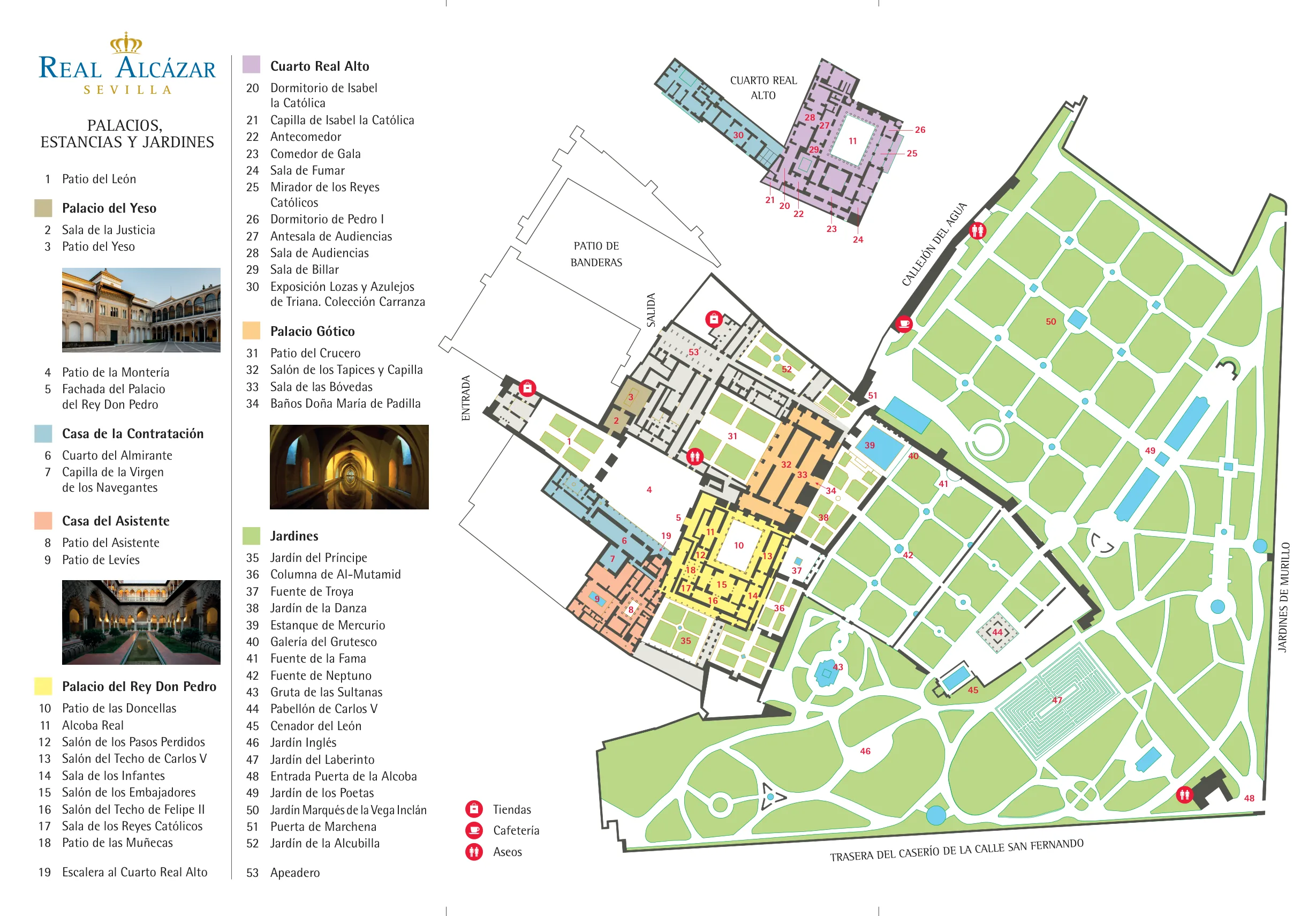
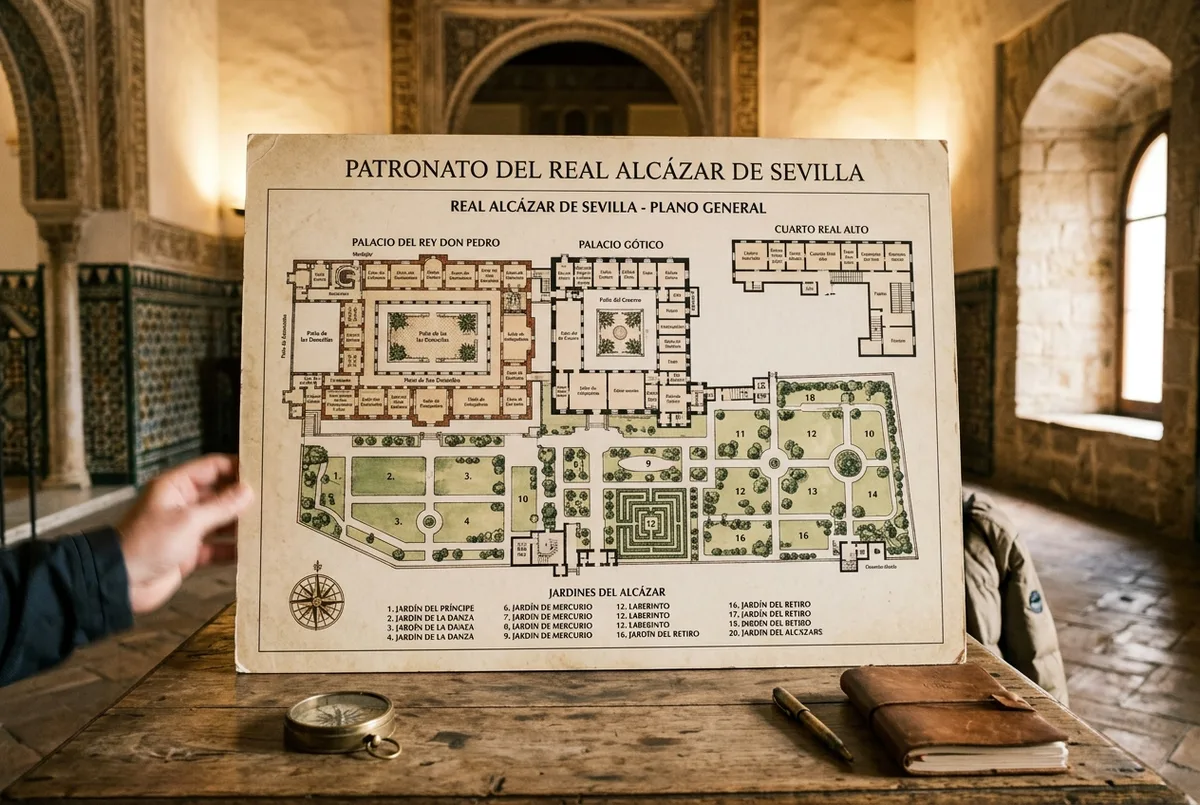
I’ve embedded the Patronato’s own visitor map above, the same one handed out at the gate, so you can zoom in on your phone before you ever queue up. If you’d rather have the full document, including the short history text on the front page, you can download it directly.
Download the official Alcazar of Seville map (PDF, ~15 MB)
I would save this to your phone the night before, since Wi-Fi inside the palace walls isn’t something I’d rely on. A downloaded PDF opens instantly with no signal at all.
What Are the Four Main Zones on the Map?
The alcazar of seville floor plan breaks into four zones once you strip away the room-by-room detail: the Palacio del Rey Don Pedro at the physical and historical center, the older Palacio Gotico and Casa de la Contratacion to its side, the Cuarto Real Alto on the upper floor, and the gardens spreading out to the south behind all three. Almost every visitor’s route moves through them in roughly that order.
I’d use this four-zone version as your mental map rather than trying to memorize all fifty-plus numbered points before you arrive. The detailed legend matters once you’re inside and orienting room by room, not before.
What’s in the Palacio del Rey Don Pedro?
This is Pedro I’s 1360s Mudejar palace, the architectural heart of the whole complex, and it’s where the Patio de las Doncellas, the Alcoba Real, and the golden-domed Salon de los Embajadores all sit clustered around a central courtyard. Most of what people picture when they think of “the Alcazar” is this one zone.
I would slow down here more than anywhere else on the map. My Alcazar history guide covers why Pedro I built this section the way he did, worth reading before you’re standing in the Salon de los Embajadores trying to take it all in.
What’s in the Palacio Gotico and Casa de la Contratacion?
The Palacio Gotico holds the Patio del Crucero, the Salon de los Tapices, and the Banos de Dona Maria de Padilla in its lower vaults, a Christian-built wing that predates Pedro I’s Mudejar work by roughly a century. The adjoining Casa de la Contratacion is smaller but historically loaded, it’s the room where Spain licensed its early voyages to the Americas.
I wouldn’t rush past the Casa de la Contratacion just because it’s modest in scale compared to the grander halls nearby. It’s easy to walk straight through it toward the more photogenic rooms, and I think that’s a mistake given what actually happened here.
What’s Upstairs in the Cuarto Real Alto?
The Cuarto Real Alto is the upper floor the map shows separately, above the Palacio del Rey Don Pedro, and it’s where the Spanish royal family still stays during official visits to Seville. Isabel la Catolica’s bedroom and chapel, Pedro I’s own bedroom, and a formal dining room all sit up here.
I would only plan around this section if you’ve specifically booked the separate, limited-capacity add-on ticket sold onsite, since it isn’t part of standard general admission. Check my Alcazar accessibility guide if stairs are a concern, since there’s no ramp alternative up to this floor.